 Found on Marshall Goldman Maryland
2017 Ferrari California T -Handling Speciale, Extended Cuoio leather
16,367 mi · townname, state
Price on request
 Sesame Cars
 Found on Ferraris Online40 photos
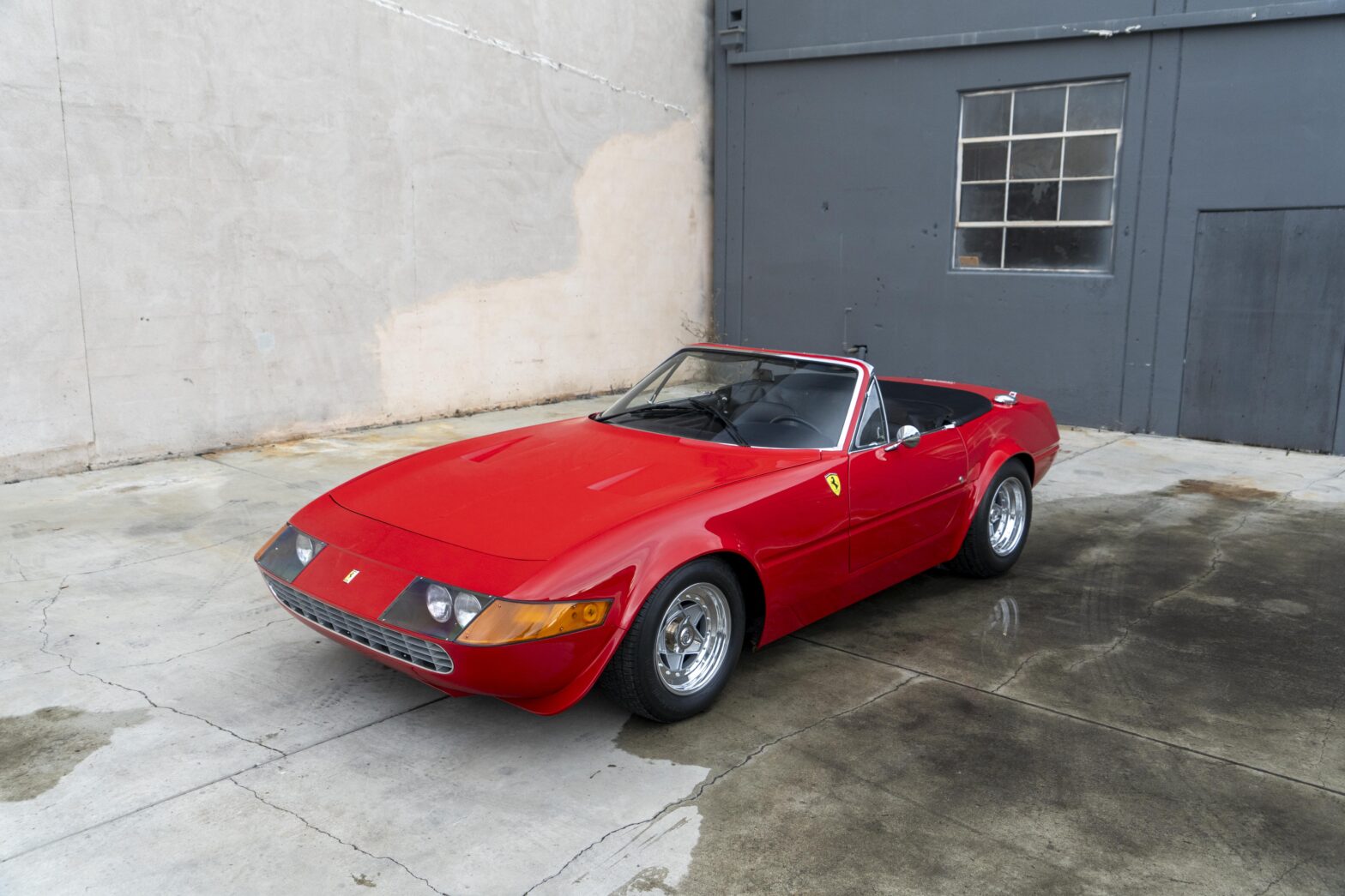
description General Information We are pleased to offer 1970 Ferrari 365 GTB/4 Spyder conversion s/n 13729, a Ferrari we have known well over the years. S/n 13729 started life as a Plexiglass headlight Euro model 365 GTB/4 Berlinetta, from new in Argento Metallizzato with a blue leather interior, sold new by official Ferrari dealer, Motor S.a.s. di Carla Allegretti e C., of Bologna, Italy before coming to the US through the port of Long Beach in 1980. In 1981, a Ferrari 365 GTB/4, s/n 13729, was rolled in Palos Verdes, California, purchased by M. Sheehan, then the owner of European Auto Sales, and later sold to Larry Crossan of Loomis, California. Over 1981-1982, Ferrari 365 GTB/4 was completely rebuilt and became one of about twenty-five Daytona coupes rebodied as a Daytona Spyder conversion by M. Sheehan’s European Auto Restoration. The repairs and Spyder conversion to 365 GTB/4 s/n 13729 were featured and pictured on pages 56, 57, 62, 113, 115 & 119 of the Braden & Roush “Daytona” book.In the mid-1980s, 365 GTB/4 Spyder conversion s/n 13729 was sold to Steve Forristall of Houston, Texas, who later offered it for sale in 1987. The car changed hands several times in the 1990s, eventually selling to Chris Minnick of Houston, Texas, before going to John Baldwin of Louisiana, who owned the car through early 2001. 365 GTB/4 Spyder conversion s/n 13729 next went to Brendan Gallaher of Pacific Palisades, CA before going to Dr. Charles Hubris of Coos Bay, Oregon in Feb., 2002. 365 GTB/4 Spyder conversion s/n 13729 was next offered by Hyman Ltd. Classic Cars and was sold in July of 2019 to a client in Seattle, WA.After purchase from Hyman Motors in 2019, the new owner contracted with Dennison International, an award-winning restoration shop in Seattle, WA. The new owner didn’t want to build another Competition Daytona conversion; instead, he wanted a drop-top Ferrari that combined a few modern touches yet captured the style of a late 1960s and 1970s racer, while also being both user-friendly and fun to drive. The transformation began in November 2019 with Dennison fabricating a new all-steel front spoiler, a new 1960s-style egg-crate grille, and new steel front and rear wheel well flares and rockers. The rocker panels were enlarged and are about two inches lower than a stock Daytona, lowering the visual stance of the car without disturbing the original suspension geometry. S/n 13729 still features Plexiglass-covered headlights. The goal was a low-and-raked look, well set up, stable, and easily drivable. Advanced Racing Suspensions built a custom set of adjustable shocks tuned for street driving while 9 x 15 front wheels and 11x 15 rear wheels with lots of rubber put the power to the ground.Starting at the front the work done by Dennison International included a front and rear bumper delete; an enlarged lower air intake opening that feeds more cool air to the radiator, an all-metal wrap-around front spoiler was added, (much like the Factory built Comp Daytonas that raced at Le Mans in 1972-73-74) and a wider anodized egg -crate grill and opening in the style of a 1960s Ferrari was fitted. All four wheel wells were flared, again similar to the Factory-built comp Daytonas, with a return edge like a modern car. Custom CNC 15-inch wheel centers with BBS barrels were machined, and flush-mounted drive flanges were fitted and nickel-plated. Advanced Racing shocks and springs were also ordered and installed. A recessed Monza-style fuel cap was also added. Modern Scuderia Fender Badges were mounted, and a Titanium shift knob was installed. After Dennison completed the metalwork, at a cost of $37,000, the car was completely painted in Ferrari Red, at a cost of $30,000, by Rillo’s Restoration in Kent, WA. The wheel hubs were $9,134.95; the CNC bill for the wheel centers was $8,973.52, and the BBS inners and outers were another $1,600.00. A new plastic rear window was another $527.49. The many hours of final assembly, setup, and sorting were performed at Goodman Racing, where the car has lived and been enjoyed since.The billet machined wheels were a project unto themselves. Designed in-house, they are machined out of 6061 Billet rounds in the style of the Factory magnesium wheels fitted to the owner’s 1969 Ferrari 312P Prototype. They are built with the same dimensions as BBS race wheels since the BBS barrels are easy to obtain for future sizing and servicing. The steel drive centers were also CNC’d and broached like the originals, but bolt in from behind, keeping the faces completely clean with no exposed hardware or trim ring, a detail that is often overlooked. The wheel drive flanges were flushed and Nickle plated. The car was originally built around period-correct Goodyear 600/800 bias-ply race tires, which looked perfect but proved less than” entertaining ” on wet Seattle pavement. It now wears BFG Radial TAs, keeping the same stance and character while making the car far more user-friendly and predictable in the wet and around town.This Daytona presents as a stunning example; the high-quality paintwork is as-new, and so is chip-, scratch-, and dent-free. The doors, hood, and trunk open and close with excellent panel fit. All emblems, lighting, and various trim are all in excellent condition. The rocker panels are slightly wider to enhance the wicked and pounce-like stance further enhanced by the competition-inspired billet-machined 9 x 15 front and 11 x 15 rear wheels, the same size as those fitted to the Factory Comp Daytonas. The wheels are obviously in as-new condition. The wider front and rear wheels are fitted with 225/60 R15 front and 255/60 R15 rear BF Goodrich T/A tires to complete the competition appearance of this remarkably constructed car.The 4.4-liter Tipo 251 Colombo V12 is essentially bulletproof and features dual overhead camshafts, a dry-sump lubrication system, and six Weber carburetors. Compression is near perfect at 170 -180 lbs per cylinder. A dependable electronic ignition has be
Found on Marshall Goldman Maryland
Description as published on the original listing. Sesame Cars does not verify seller claims.
 Found on Marshall Goldman Maryland
 Found on Marshall Goldman Maryland