
 Found on Bring a Trailer
This car is also listed on Curated. Search shows that listing as the main one.See main listing
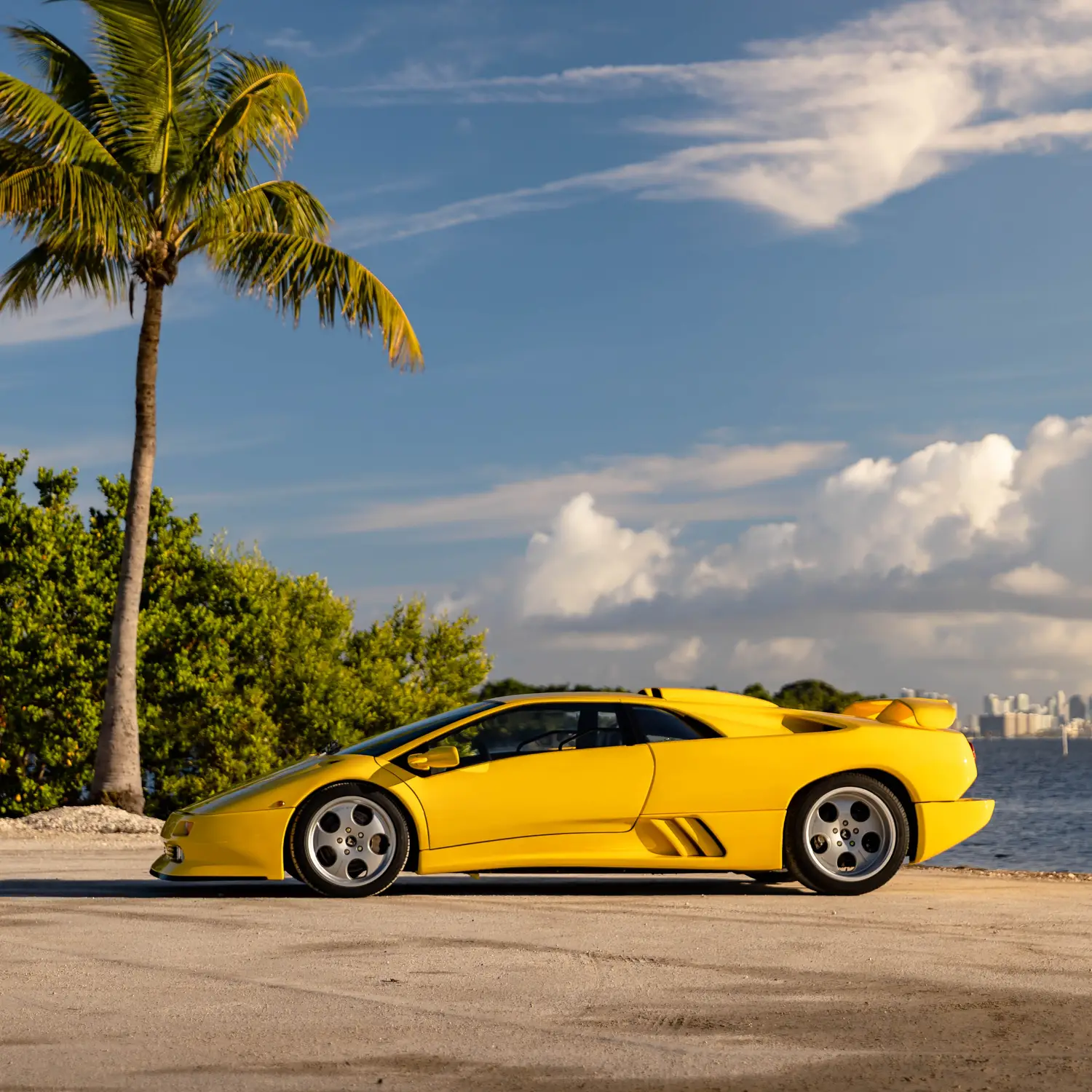 Found on Curated37 photos
1995 Lamborghini Diablo SE30 JOTA
5-speed manual · Giallo over blue leather
$300,000Listed 2 days ago
Mileage
235 mi
Transmission
5-speed manual
VIN
ZA9DE22A0RLA12116
Specifications
- Year
- 1995
- Make / Model
- Lamborghini Diablo
- Trim
- SE30 JOTA
- Exterior color
- Giallo
- Interior color
- Blue Leather
- Seller type
- Dealer
Description
Included: Set of keys, export plates, cover, manual, service history paperwork Third in line of the Lamborghini V12 supercar sequence, supplanting the Miura and Countach respectively, the fabulous Diablo represented a fresh direction for Lamborghini’s flagship V12 model. The Diablo series began in 1990, ending the sixteen-year production of the iconic Countach. The Diablo series production ran for eleven years to 2001 through some rough financial times for the company which saw multiple changes in ownership and design directions. Design of the Diablo was originally carried out by Marcello Gandini who had designed the Miura and Countach for Bertone, under contract with Swiss brothers and Lamborghini financiers, Jean Claude Mimran and Patrick Mimran, who started the design process called Project 132 in 1985. Chrysler’s purchase of Lamborghini in 1987 further delayed the debut of Project 132 as the new parent company was not comfortable with Gandini’s design and as long as Chrysler was funding the project, the design had to go their way with a lot riding on the new car, a team of designers in Detroit was assigned to the project in order to refine what Gandini had started. Chrysler’s design team headed by Tom Gale softened some of the hard edges and corners and so while the car very much kept the Lamborghini sensibilities, it wasn’t as over the top and rakish as Gandini, who had been named among the top car designers of the century, would have preferred. What came out of the design-by-committee was a dramatic and spectacular car keeping the Countach signature touch scissor doors but that was where the similarities ended. Lamborghini/Chrysler wanted a 200+MPH car capable to keeping up with competitors such as Ferrari F40, Jaguar XJ220 and newcomer McLaren F1 which quickly took the mantle of fastest road car. In 1994, Chrysler and Lamborghini parted ways, the company was sold to a group of Indonesian investors and by 1998 was sold again to Audi AG (the Volkswagen Group). Throughout the turbulent times at Lamborghini, the Diablo survived as production was never halted. Upon Audi’s take-over of Lamborghini, a project was set to modernize and update the Diablo as the replacement Murciélago was in the works. Audi contracted Luc Donckerwolke to design a more refined, modern Diablo and in 2000, the VT 6.0 (commonly known as the 6-liter or 6.0) was born. The Diablo 6.0 featured significant styling and performance changes under Donckerwolke’s direction, the last of the Diablo range ran for only two years, 2000-2001with a mere forty examples produced. Donckerwolke made subtle changes to the Diablo, most notably at the front with inset headlights instead of the usual popup’s. Under the headlights, the air dam with large air intakes ahead of the front wheels while further refinements included further smoothing of hard lines of the fenders sweeping back to the enormous rear section which remained largely the same with huge air ducts atop the rear fenders with dramatic air ducts atop the engine bonnet to help keep the big, snarling 6-liter, 543BHP V12 cool. The wheels were changed from three-piece alloys to a 18” O.Z. “phone dial” rims holding up the massive Pirelli P-Zero 335/30 ZR 18 tires at the rear. The car has a massive presence and correlations may be clearly drawn between the 6.0 and the Murciélago which was the Diablo’s V12 replacement which began production in 2001. Inside, the 6.0 was further refined, gone was the familiar rectangular interior of the Countach in favor of a sweeping leather dash with the instrument cluster thoughtfully spread out, creating a more comfortable and luxurious cabin with added carbon fiber touches throughout with the famous six speed gated shifter sitting atop the console with actual working air conditioning and sound system. The looks of the Diablo 6.0 prompted Top Gear’s Jeremy Clarkson to state that the car to be “Solely, the biggest head-turner in-the-world”. Descriptions of how the 6.0 drives range from “600 horsepower rage” to “Not a car for everyone”. Only 150 SE30 models were built with only about 15 being converted to JOTA specification and 28 JOTA kits being produced. The JOTA derivative was a factory modification made to meet homologation specifications so the racing version, the Diablo SV-R could participate in the Lamborghini Supertrofeo Series and Japanese Grand Touring Series (JGPDS) as mandated by the FIA which were designated JOTA PO.01. The JOTA kit features: • Racing ECU • Forced intake and unique intake manifold system • Unique racing cams • Unique functional rear hood scoops • Unique exhaust system • 400km/h speedometer • Small “JOTA” badge The Diablo JOTA got a new ECU, new cams, new intake, an incredibly loud exhaust (creating nearly 600BHP from its naturally-aspirated V12, 4-valve engine), fixed suspension, adjustable sway bars and lightweight plexiglass windows instead of glass. Perhaps the biggest visible differences on the JOTA are the ducting vents atop the engine cover and a return to pop-up headlights. The JOTA also features a dramatically revised snow plow nose which houses four more fog lights mounted down low and a big rear wing, the JOTA is very much the racing version of the Diablo SE30 and the MSRP was $300,000 when new. This 1994 Lamborghini Diablo SE 30 JOTA (#12116) is a Euro version left hand drive example in brilliant Giallo with blue leather interior
Price history
Tracked by Sesame Cars since Oct 2026Lowest price
$300,000
Oct 21, 2026
Average price
$300,000
Last 6 months
Highest price
$300,000
Oct 21, 2026
Similar vehicles
More DiablosFound on Bring a Trailer