
 Found on Curated8 photos
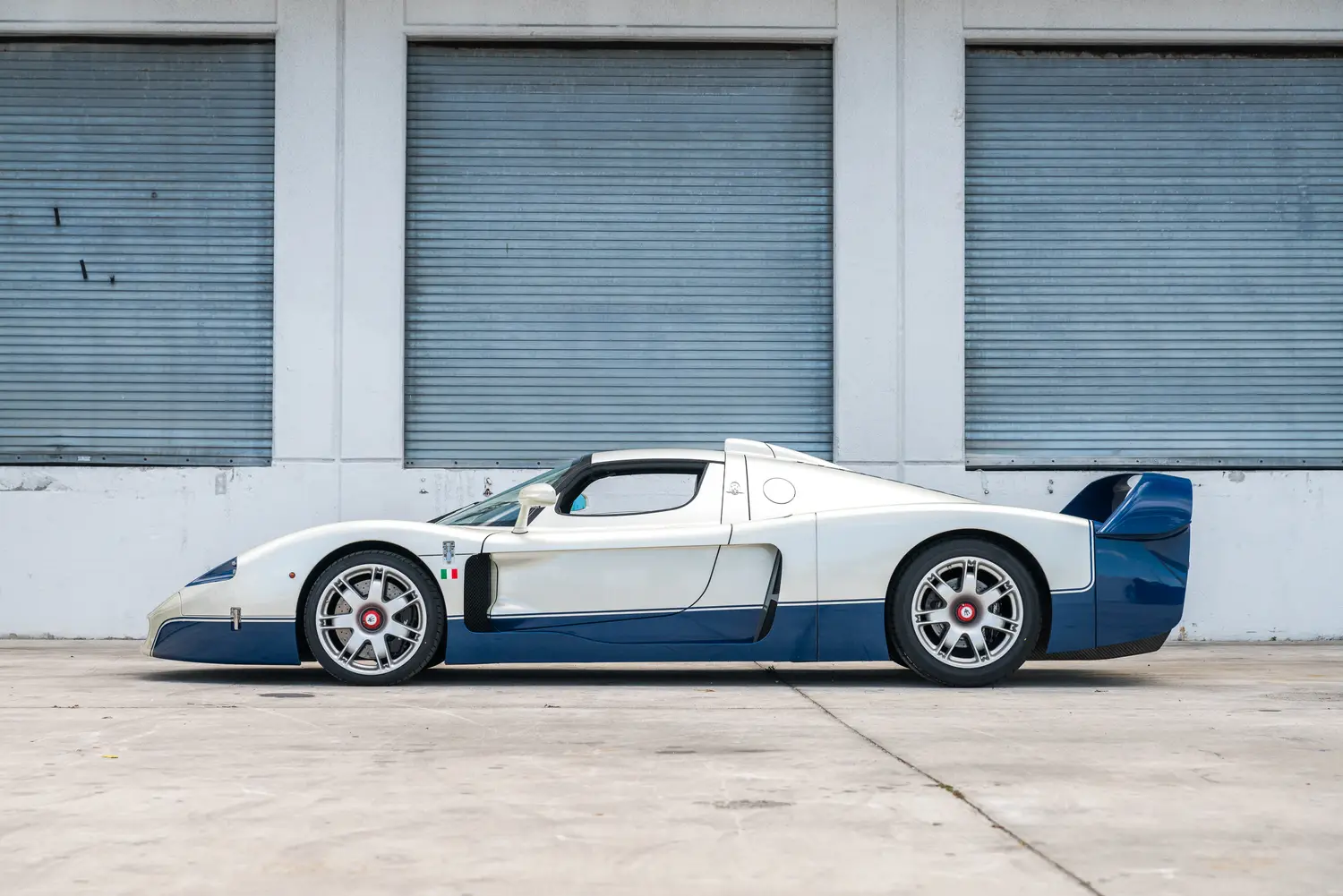
2005 Maserati MC12
Top speed
$670,000Listed 2 days ago
Mileage
3,300 mi
Transmission
Top speed
Specifications
- Year
- 2005
- Make / Model
- Maserati MC12
- Seller type
- Dealer
Description
The Maserati MC12 (also known as MCC or Tipo M144S) was the result of the historic Modena-based brand’s revitalization under Ferrari SpA’s guidance and entering the Supercar arena in 2004. The dramatic cars were built on the Ferrari Enzo platform and designed by Frank Stephenson, the American designer whom also penned the Mini Hatch, BMW X5, FIAT 500 Punto and Bravo, Alfa Romeo MiTo, Ferrari F430, McLaren P1 and MP4-12C. Stephenson was named “one of the most influential automotive designers of our time” by Autoblog in 2008. In the late 90s, FIAT sold controlling shares of Maserati to Ferrari which is also part of the FIAT Group. Ferrari President Luca di Montezemolo set about to revive Maserati under Ferrari’s umbrella. Maserati, the long-time king of Italian sports and touring cars which featured the iconic original Ghibli (in coupe and spyder forms) from the late 1960s through early 1970s was to be made Ferrari’s luxury brand through the introduction of two new models intended to raise the company’s profile replacing the de Tomaso designed 3200 with the slick new Coupe which was a true four seater and Spyder the neat two seat convertible. Maserati dropped the twin-turbo V8 engines of the 3200 for normally aspirated 4.2 liter V8s which were based on Ferrari’s hugely successful 360 motors. The cars also featured a transaxle gearbox mated with Maserati’s version of the now familiar paddle shifters which were termed “Cambiocorsa”. The reception to the new generation of Maseratis under Ferrari’s direction was generally cool to positive depending on whom was asked. None the less, order books filled quickly in the now combined Ferrari/Maserati showrooms with long time Ferrari customers willing to step up and buy Maseratis to use as daily drivers and save their Ferraris for weekends. Unfortunately, anticipation for the new look Maseratis was met with a lot of issues which plagued the first generation of Ferrari-inspired Maseratis. The Coupe and Spyder were beset with numerous mechanical maladies mainly related to electrical issues and the “Cambiocorsa” controlled transmissions. The new Maseratis were burdened with the bad reliability tag and Maserati was on the back foot in trying to calm buyer’s fears particularly in the U.S. where Maserati had a rather marginal reputation. Frank Stephenson was given a greater role as Director of Ferrari-Maserati Concept Design and Development and soon enough, Maserati worked out the reliability issues and the new models were beginning to make an impact in the market. Galvanized by the addition of the Quattroporte V designed by Pininfarina’s Ken Okuyama, Maserati brought back the retro-inspired but thoroughly modern big sedan which first appeared in 2002. The Quattroporte V was put into production in 2003 and was by all measures the big hit Maserati needed, di Montezemolo was ready to take Masearti to new levels. Quite in character, di Montezemolo also targeted racing as a way of promoting the Maserati brand with competition modified Coupes which appeared in single make Maserati Supertrofeo series as Ferrari Challenge Series undercard events but not really making and headlines in more relevant sports car series. That was until the introduction of Stephenson’s masterpiece, the stunning MC12. Maserati’s ultimate statement first entered production in 2004 with a twenty-five car run and another twenty-five examples for 2005. Each of the fifty cars were quickly spoken for at a pre-production cost of $670,000 as collectors lined up for what was sure to be a classic collectible Maserati with Supecar and racing lineage the likes of which had not been seen since the original Tipo 60 Birdcage. The Maserati MC12 brought the brand firmly into the Supercar realm and while it was built on the Ferrari Enzo platform, the appearances of the cars are strikingly different. The MC12 is much more of a full-bodied prototype than its older cousin and seems purpose built for racing taking its place among the elite of sports car innovation and design, the MC12 is what the Enzo would be without the restrictions for daily road going use. The only real outward visual evidence of shared DNA between the Enzo and the MC12 was that they had a common windscreen. Under the skin, the MC12 is the same chassis and track dimension and a common Ferrari-built 6.0 liter V12 engine (rebadged with Maserati branding) and drive train was employed. The fully carbon fiber car was developed entirely in the wind tunnel in order to achieve maximum downforce across all surfaces. The dramatic fixed rear wing (which is huge by today’s standards) exaggerates the length of the car making the it a definitive long-tail. The underside and the rear bumper areas were done away with and replaced by a racing derived defuser to achieve ultimate ground effect. Stephenson’s mandate must have been to get as much air into the car’s radiators as possible and he achieved this by adding large straked inlets into the car’s front bonnet and atop the front splitter. Two enormous air intakes run nearly the full length of the side pods culminating with inlets to cool the engine. Likewise, a Formula One inspired air scoop atop the engine bonnet not only raises the MC12s profile but further aides in cooling the V12 motor through the forced duction system. Maserati MC12s came in only the beautiful pearlescent white with blue accent color scheme. The color combination was an homage to the American Camoradi racing team, the famous entrant for the Tipo 60 Birdcage entries of the early 1960s. However, for an extra fee, Maserati would make an MC12 available in bespoke colors. A few took Maserati up on this and there are some notable bespoke colored examples in solid blue, black and orange. While unquestionably a real looker of a car, criticisms of the MC12 included that it was just too big, no rear window, spare tire or entertainment system and the way the engine seemed to be limited on the top end disappointed owners whom expected more performance. Development driver Andrea Bertolini who tested the initial MCC was enthusiastic about the car’s reliable and positive reactions. However, others were quick to complain that the MC12 was twitchy (overly sensitive to the least little driver input steering, braking, acceleration, etc.) and questions about how the car was categorized. Was it a street car, a GT racer or a full purpose-built prototype? The short answer was, well, yes! And, perhaps even more interestingly, racing sanctioning bodies from the FIA, ACO, IMSA to the SRO were all left in the same _conundrum as to how the car would be classified in racing. It seemed that the MC12 did not really fit into anyone’s idea of what a GT or prototype was._ The MC12 was in fact faster than its cousin from Maranello, but only marginally. In 2008, an MC12 lapped the Nurburgring Nordschleife in 7M:24.29S, over a second faster than an Enzo. Likewise, the MC12 was faster than the Enzo on Top Gear’s airport road course as driven by “The Stig” by just less than a second. So, were all of the modifications really worth it? **Racing, But of Corse…** It would seem that the MC12 was built nearly a decade too late as similar type cars such as the AMG Mercedes-Benz CLK-GTR, McLaren F1, Porsche GT1 and Lotus GT1 each saw action on the world stage in the enormously popular FIA GT series in the mid to late-90s while producing a string of memorable races, championship chases and a class of road-going and racing investment cars which to this day command record sums by collectors. Despite the sanctioning bodies’ concerns, Maserati committed to build twelve racing version MC12s, called the GT1, to compete in the SRO organized FIA GT series and entered by the Italian A.F. Corsa team for 2004. All this, despite the fact that the FIA would not allow the MC12 cars to score championship points due to the debated homologation. This would not be the last time the appearance of the MC12 on the global racing stage would create controversy,
Price history
Tracked by Sesame Cars since Oct 2026Lowest price
$670,000
Oct 21, 2026
Average price
$670,000
Last 6 months
Highest price
$670,000
Oct 21, 2026

